
The False Binary
Why Egalitarianism Isn't the Opposite of Complementarianism
This week, I’m stepping away from my Reading Ephesians Together series to chase down a spark that lit up my brain. It came from a Substack note by Anni Ponder , cute dog picture and all. She asked a simple but disarming question: Can we stop treating complementarianism and egalitarianism like polar opposites?
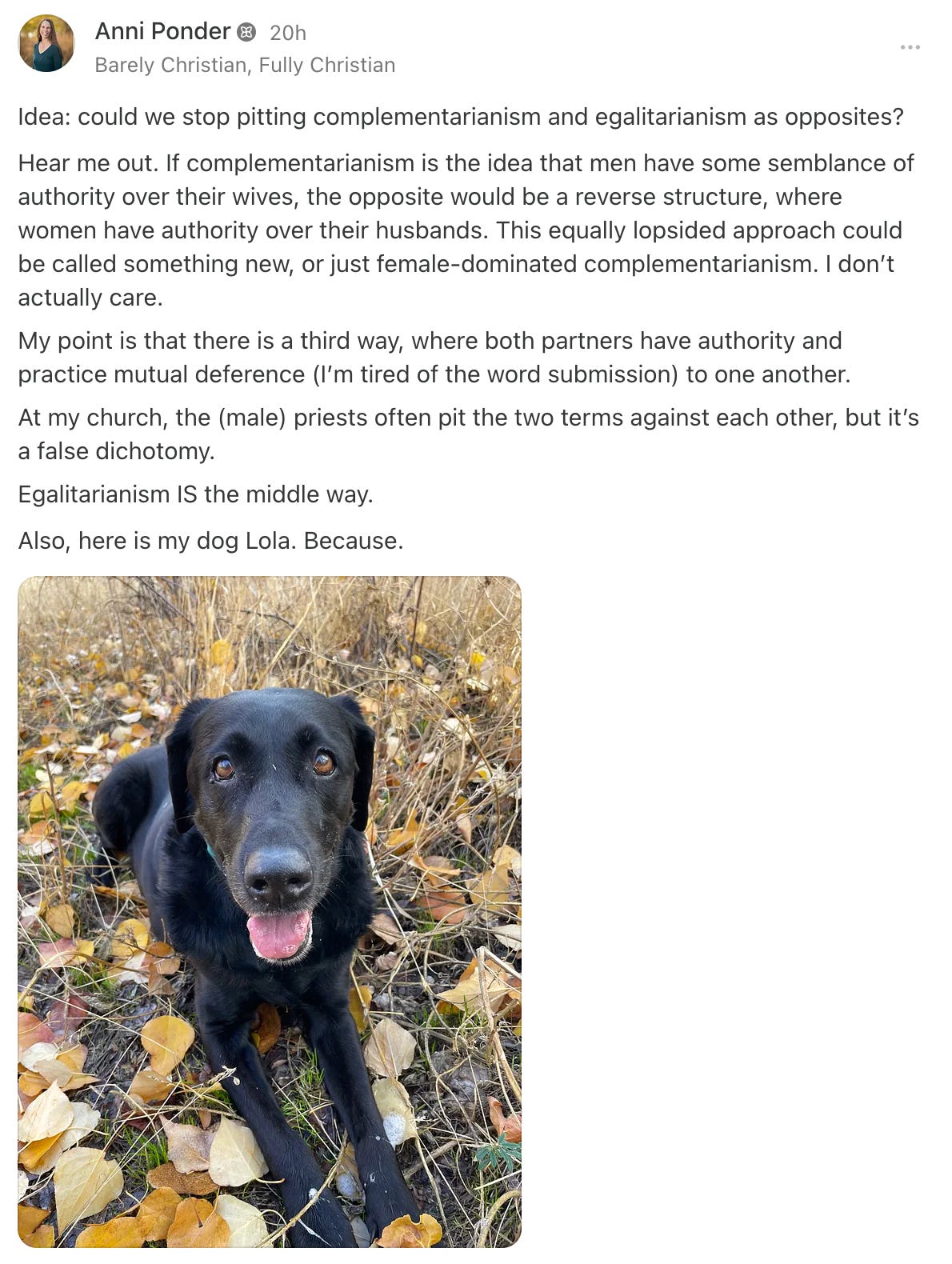
I’ve been mulling that ever since. And the more I mull, the more I realize I’ve been guilty of the very thing she’s calling out. I’ve framed the debate as between the HC/Complementarians and the MC/Egalitarians.1 One side insists on male headship; the other insists on… well, something else. But Anni’s point is sharper: the true opposite of male-only leadership isn’t “no leadership.” It’s female-only leadership.
Everything else is a false dichotomy.
I want to share another example of this false dichotomy at play. Intents Of The heart also shared an exchange she had with a man who was convinced that rejecting male headship equals rejecting all authority:
“Every man accepts that he must obey appropriate authorities. Why—WHY—do women ROUTINELY argue that they should not have to obey the authority that their husband is given over them by God? This is moral suicide and it needs to stop… EVERYONE is under authority. WISE people admit this and act accordingly. Foolish people join the devil in declaring themselves an authority unto themselves.”
Notice the move. It’s all-or-nothing. Either you accept his version of hierarchy, or you’re a rebel declaring yourself God. There’s no middle ground. No third way.
But that’s the trap. He’s not actually arguing against MC/Egalitarianism. He’s arguing against a straw woman he’s built in his head, one who wants to flip the hierarchy and put wives in charge. And yes, that version exists in the world. You can find it in certain corners of culture that do want to diminish men and exalt women. But that’s not me. And I bet many other writers on this topic would agree. MC/Egalitarians would stand shoulder-to-shoulder with HC folks to say, “No, that’s not the way either.”
I’ve written before about the zero-sum game. Picture a pumpkin pie at Thanksgiving. There are only so many slices. If I take two, you get one. That’s zero-sum. It works in pie. It works in some economics. But does it work in marriage?
HC/Complementarians often treat authority like that pie. If the husband has the bigger slice, the wife gets the smaller one. If she gets more, he gets less. Leadership is finite. Someone has to have the final say.
But what if authority in marriage isn’t a pie at all?
What if it’s more like love? Or grace? Or the way Jesus talks about power in the Kingdom? When a husband serves his wife sacrificially, does his authority shrink? No—it’s transformed. When a wife steps into co-leadership, does her husband’s capacity get halved? No—it’s doubled.
This is the upside-down logic of the gospel. Power isn’t seized. It’s shared. It’s poured out. It’s multiplied in self-emptying.
If I were to diagram the actual opposite to HC/Complementarity, it would look like this:
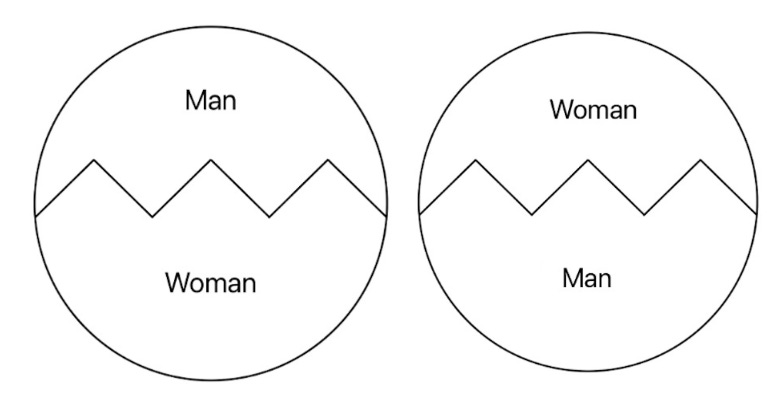
However, MC/Egalitarianism is often discussed and implied as the opposite. In reality, the middle way—the third way—is shared leadership.
Let me draw it properly:
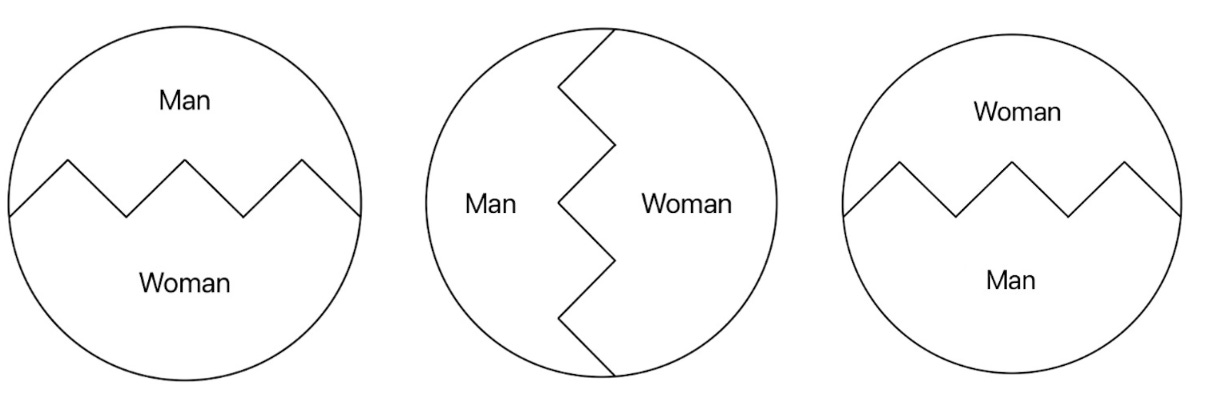
MC/Egalitarianism isn’t the absence of leadership. It’s not the rejection of complementarity. It’s the insistence that complementarity doesn’t require hierarchy.
Men and women are different. We bring distinct gifts. That’s not the debate. The debate is whether those differences must be ordered in a chain of command.
For that, let’s go back to the garden.
Hard Complementarians often read Genesis 1–2 and see a divinely created order. An org chart of sorts. Adam → Eve → animals. But is that really the point?
Read it again. God creates humanity in His image—male and female (Gen 1:27). No hierarchy mentioned. Then Adam is alone. Not good. So God creates Eve—not as a subordinate, but as ezer kenegdo—a strong ally, a corresponding strength.
They are naked and unashamed. No shame. No shame in difference. No shame in equality. And how is the whole chapter summed up? Two becoming one. From isolation to union and companionship.
Then the fall happens. And what does the enemy target? Oneness. He drives a wedge. Division. Shame. Blame. It is not about turning authority structures upside down at all.
I’ve been walking through Ephesians verse by verse, and I keep coming back to this: Paul isn’t writing a marital org chart. He’s writing to a stratified, patriarchal culture and saying, “In Christ, everything changes.”
Look at the structure:
Wives, submit to your husbands as to the Lord (5:22)
Husbands, love your wives as Christ loved the church and gave himself up for her (5:25)
In reality, these are two sides of the same coin. Paul isn’t obsessed with who has the final say. He’s obsessed with mutual self-giving. He’s calling husbands—used to being in charge—to die to that power. To wash feet. To lay down their lives.
And wives? They’re called to submit as the church submits to Christ—but remember, the church submits to a Christ who emptied himself. This isn’t top-down. It’s circle-shaped.
Mutualism isn’t capitulating to culture. It’s not declaring ourselves “an authority unto ourselves.” It’s the harder, humbler path: two image-bearers, walking as co-heirs, co-leaders, co-laborers in the mission of God.
It’s Philippians 2 in marriage form:
“In your relationships with one another, have the same mindset as Christ Jesus: Who, being in very nature God, did not consider equality with God something to be grasped; rather, he made himself nothing…” (Phil 2:5–7)
When both partners adopt this posture, the need for a “final say” evaporates. You don’t need a tiebreaker when you’re both laying down your lives.
The garden wasn’t a corporation. It was a friendship. A partnership. A shared dominion.
And Jesus’ prayer wasn’t for perfect org charts. It was for oneness:
“That all of them may be one, Father, just as you are in me and I am in you… I in them and you in me—so that they may be brought to complete unity.” (John 17:21–23)
That’s the telos. That’s the middle way.
And if we let the mutualist reading of Genesis be our lens—if we let the leaven of the Kingdom work its way through the household codes, through culture, through time—we’ll see God doing what He’s always done:
Making all things one.
I regularly use the terms HC/Complementarian and MC/Egalitarian in my writing. This stands for Hierarchical-Complementarian and Mutual-Complementarian. This is because both positions believe in the complementary nature of men and women. The significant divide is whether one person is in charge or leadership is shared.
Well said. I do wonder how many men are clinging to the complementarian view because of how it makes them special and essential. If you take away a man's authority, what is he left with? If men really comprehended their value in Christ. period. I think many would loosen their grip on needing to be a leader & provider, and needing to prove their worth.
I used to be a complementarian. That realization (and much soul searching) is one that stopped me cold.
yes. so often - not just in this conversation - we create a false binary when almost just as often it’s actually secret answer “c.” and too often this false binary drives us to win the argument instead of trying to meet people where they are.
so often we’re much closer practically than it seems from our us/them approach.